OpenAI launched Businesses in ChatGPT as a beta on November 10, 2026. It has two parts: a Business Hub where companies claim and manage a business profile in ChatGPT, and Business Agents that answer customers' questions about a company's products. Business Agents are initially limited to eligible ecommerce and online service businesses in the United States, PYMNTS reports. For advertisers, Business Hub also reports how often a business is mentioned in ChatGPT answers.
What is Business Hub in ChatGPT, and who can use it?
Business Hub is where a company manages its presence in ChatGPT. According to PYMNTS and TechCrunch, businesses can:
- claim and verify a business profile, then update its information
- add product feeds with pricing and availability
- connect a Shopify store, either from Business Hub or from Shopify's admin
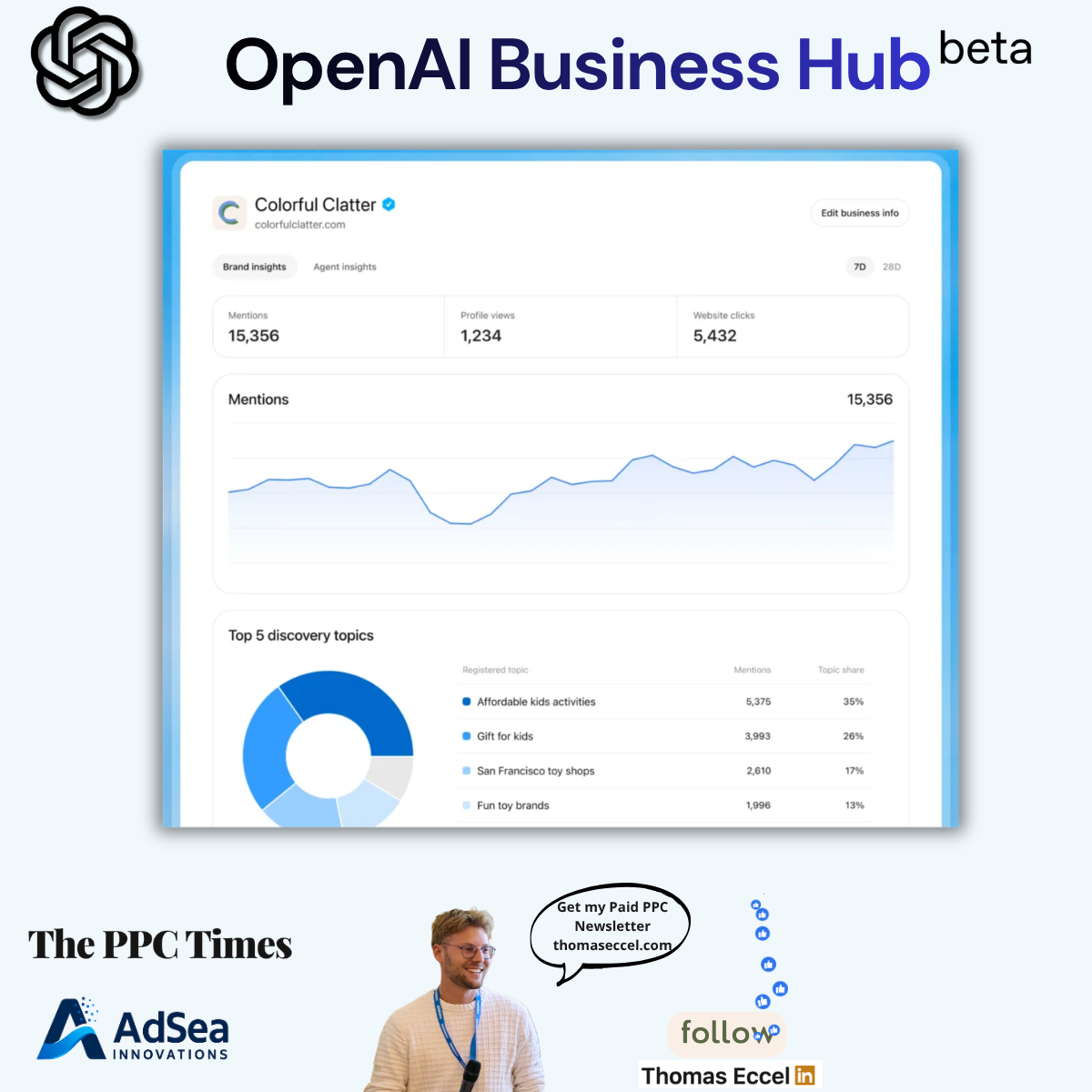
- see aggregated insights: how often the business is mentioned in ChatGPT answers, website clicks, and the common topics of conversations where its website appears. TechCrunch also lists profile views.
Verification goes through a formal process. TechCrunch reports that OpenAI did not share the details, and that Benji Shomair, OpenAI's VP of Monetization, told journalists there are several verification methods for different types of business and different markets.
Business Agents sit on top of the profile. Once a profile is claimed, an eligible business can build, test and launch an agent that answers questions about its products and services. When a participating business shows up in a ChatGPT answer, users can open its profile and start a separate conversation with the agent to explore and compare products, PYMNTS reports.
On privacy, OpenAI said businesses will not see individual user conversations or chats with their agent, and that engagement data only appears once activity passes certain thresholds, according to PYMNTS. The thresholds were not given. OpenAI also said it plans to expand Business Agents to more markets and business categories.
OpenAI's own Businesses in ChatGPT page has the full details. It blocks automated access, so this article relies on the two news reports above.
Why it matters for advertisers
Mention counts, website clicks and discovery topics could give marketing teams an official view of their visibility in ChatGPT, data that comes from OpenAI rather than from third-party tracking tools. TechCrunch compares the profiles with the ones Google and other search engines offer.
The discovery topics are likely to be the most useful part for paid search managers. They show which themes ChatGPT links a business to, which could feed keyword research, ad copy and landing page priorities on other channels.
Product feeds and Shopify connections suggest that clean product data matters in ChatGPT just as it does in Google Merchant Center. Retailers who already maintain a good feed are likely to have a head start.
The limits matter too. The insights are aggregated, small businesses may fall below the reporting thresholds, and Business Agents are US-only for now. The sources don't say whether a profile affects how often ChatGPT recommends a business, so it is safer not to assume it does.
What to do now
- Check eligibility: if you run a US ecommerce or online service business, look at the Businesses in ChatGPT page and claim your profile.
- Fix your business data first: make sure prices, availability and product details are current before connecting a feed or Shopify store.
- Compare the numbers: set the Business Hub website clicks against ChatGPT referral traffic in your own analytics.
- Use the discovery topics: compare them with your search terms report to spot themes you aren't covering.
- Outside the US: claim the profile if you can and watch for Business Agents reaching your market.
- Test an agent carefully: whatever the agent says represents your business, so check its answers on prices, delivery and returns before launch.