
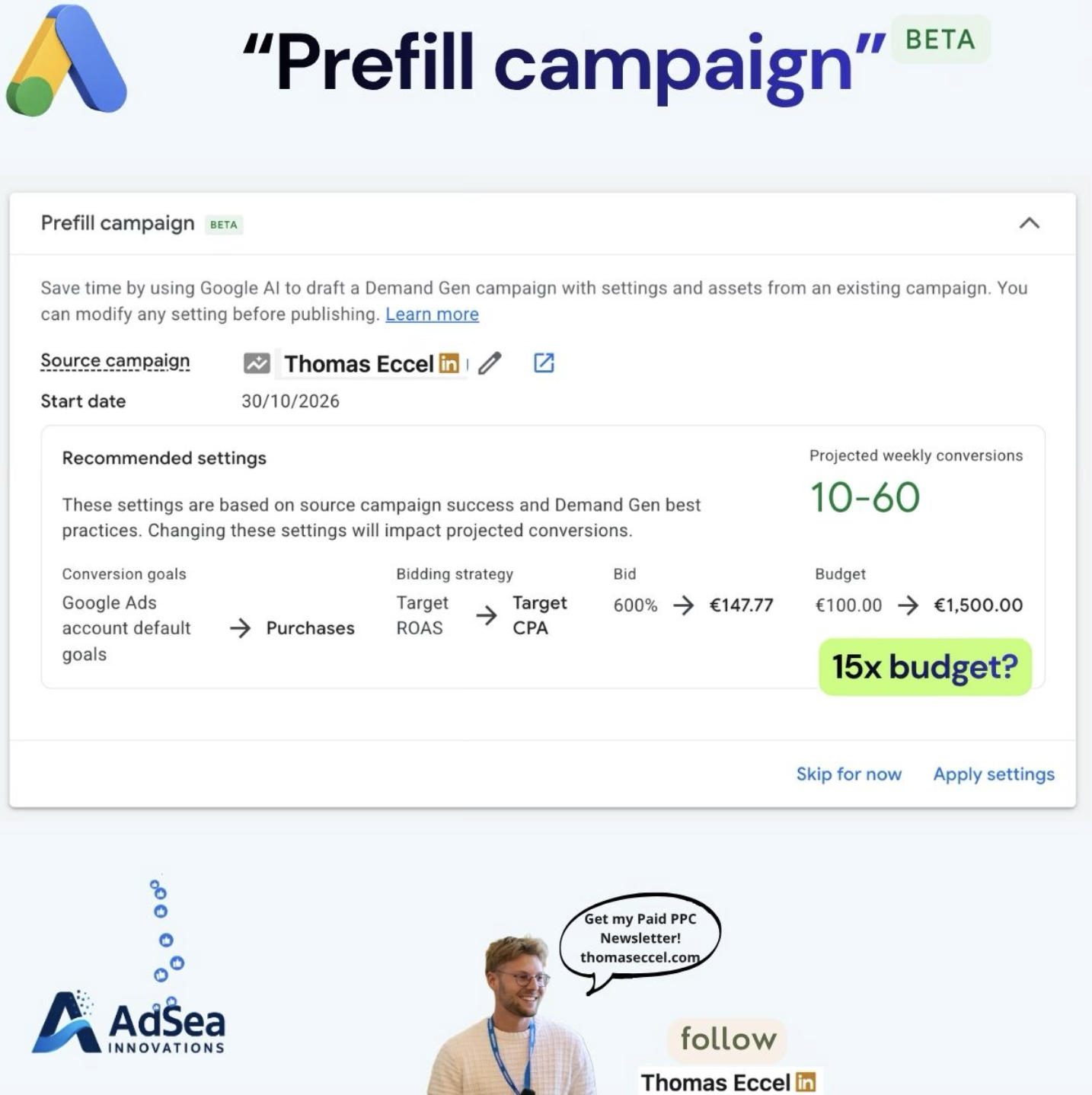
Google Ads appears to be testing a beta called Prefill campaign, which uses Google AI to draft a Demand Gen campaign from one an advertiser already runs, according to a LinkedIn post by PPC Times editor Thomas Eccel and his screenshot of the panel. Which accounts have access is unclear. We found no Google Ads Help page for the feature, and a Google business page that appears to relate to AI-assisted Demand Gen creation sat behind a consent screen and could not be read, so Google has not confirmed these details in any source we were able to read.
What is the Prefill campaign beta in Google Ads?
The panel in the screenshot is labelled Beta. Its description reads: "Save time by using Google AI to draft a Demand Gen campaign with settings and assets from an existing campaign." It also says any setting can be modified before publishing.
Eccel's post describes the source as a Performance Max campaign, with audience settings, assets and core configuration carried over, plus AI suggestions for bidding, target CPA and daily budget. The panel itself says only "an existing campaign", so the eligible campaign types remain an open question.
The panel says its recommended settings draw on the source campaign's success and on Demand Gen best practices, and that changing them will affect projected conversions. In the account shown, it proposed:
- Conversion goals: Google Ads account default goals to Purchases
- Bidding strategy: Target ROAS to Target CPA
- Bid: 600% to €147.77
- Budget: €100.00 to €1,500.00
- Projected weekly conversions: 10-60
The advertiser can then choose Apply settings or Skip for now. The proposed budget is 15 times the source figure, and Eccel's post singles it out as the main problem with the beta.
Why it matters for advertisers
A tool like this could shorten the work of testing Demand Gen for advertisers who already have a campaign with usable assets and conversion data. The risk sits in the recommendations, which arrive as one block behind a single button.
This is one example from one account, so it says little about how Google sets budgets in general. It does show how far a suggestion can move from the source. If the €1,500.00 is a daily budget, as Eccel's post indicates, and all of it were spent, a week would cost €10,500. Against 10 to 60 projected conversions, that works out at between €175 and €1,050 per conversion by our own calculation. Both ends are above the €147.77 target shown in the same panel.
The bidding change also deserves attention. Moving from a return target to a cost-per-conversion target changes what the new campaign is being asked to deliver, so results may not be directly comparable with the source.
What to do now
- Check whether the option appears when you build a Demand Gen campaign. We don't know how widely the beta is available.
- Treat the output as a draft. Review each line of the recommended settings before choosing Apply settings, since the panel says all of them can be edited.
- Set the budget yourself, based on what you would have approved without the suggestion and on your own cost per conversion.
- Compare the proposed conversion goal with the one your reporting relies on, especially if the source uses account default goals.
- If you do run a prefilled campaign, you may want to record the original suggestions so you can compare them with actual spend and conversions later.