Google has removed statements about IP addresses from its Consent mode reference page in Google Ads Help. The page no longer says "Ads products truncate IP addresses at collection" for traffic where ad_storage is denied, and no longer states that Google Analytics does not store or log IP addresses sent in cookieless pings. The PPC Times' help page watcher detected the change on November 25, 2026. The page does not say why the lines were removed.
What changed on Google's consent mode reference page?
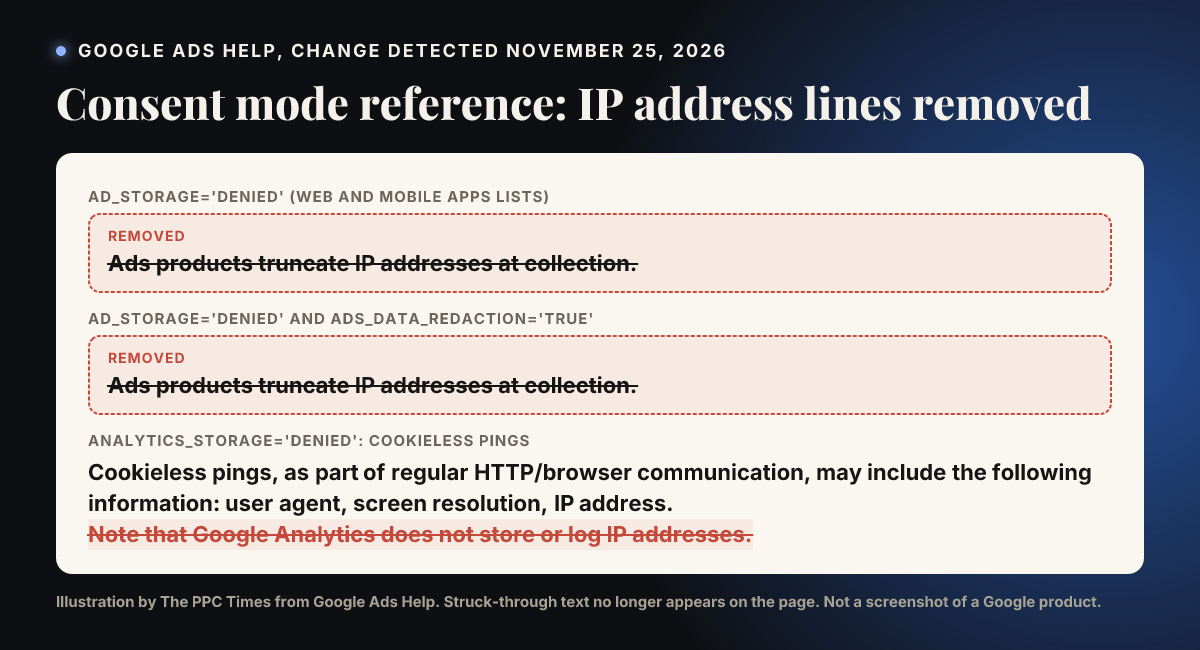
The Consent mode reference page lists how Google tags behave for each consent state. It is written for Google tag users who receive user data from people in the European Economic Area (EEA). Comparing the version the help page watcher stored before November 25, 2026 with the current one, four lines are gone:
- ad_storage='denied': the line on Ads products truncating IP addresses at collection was removed from both the Web list and the Mobile apps list.
- ad_storage='denied' and ads_data_redaction='true': the same line was removed.
- analytics_storage='denied': the page still says cookieless pings may include the user agent, screen resolution and IP address. The note after it, stating that Google Analytics does not store or log IP addresses, was removed.
The rest of those sections reads as before. With ad_storage denied, the page still says no new advertising cookies may be written, existing first-party advertising cookies are not read, and requests go through a different domain. With ads_data_redaction on, it still says ad-click identifiers such as GCLID and DCLID are redacted in Google Ads consent and conversion pings. Where all consent is granted, the page still lists IP address collection.
Why does the change to Google's consent mode page matter for advertisers?
The help page no longer documents what happens to IP addresses when consent is denied. That is a change to the documentation, and the page does not say whether Google's handling of IP addresses has changed.
Advertisers and their legal teams sometimes rely on this page when they describe consent mode in privacy notices, consent banners, data protection impact assessments or internal records. Text that quotes or paraphrases the removed lines could now point to statements Google's help page no longer makes.
Consent management platform (CMP) vendors and agencies that have built client documentation on the old wording may also be affected.
What to do now
- Search your privacy policy, cookie notice and internal consent mode documentation for wording about IP truncation or Google Analytics not storing IP addresses.
- If you cite Google's help page as the source for those statements, check the current version of the page before relying on it.
- Consider asking your Google representative, or your data protection contact at Google, how IP addresses are handled for denied-consent traffic today.
- Ask your legal or privacy adviser whether any documents need updating. The PPC Times does not give legal advice.
- Keep a dated copy of the page for your records, since help pages change without notice.