Performance Max campaigns built only on a Merchant Center feed, with no text, image or video assets, are picking up traffic on Display, Gmail, Discover and YouTube, according to a LinkedIn post by PPC Times editor Thomas Eccel. He reports that this traffic takes share away from Shopping. Retailers who use feed-only setups to keep PMax close to a Shopping campaign are the ones affected. Google has not announced any change to how feed-only campaigns serve, so this is a reported pattern from live accounts, not a confirmed policy.
What's changing
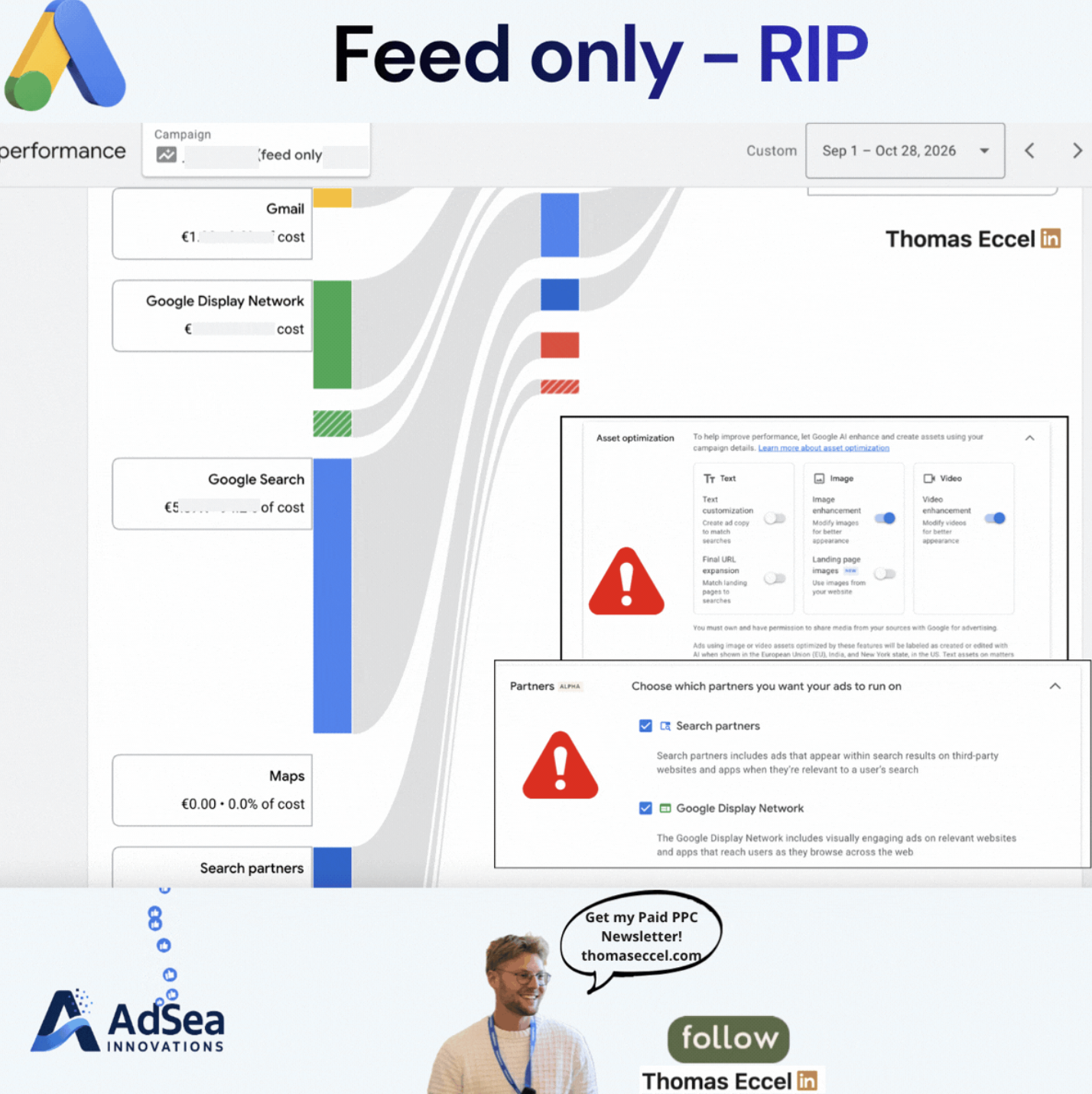
The screenshot comes from a campaign named as feed only, with a date range of September 1 to October 28, 2026. The channel performance report shows cost on Gmail, the Google Display Network, Google Search and Search partners, with €0.00 on Maps. Google's help page for the channel performance report lists Google Search, Google Display Network, YouTube, Discover, Maps, Gmail and Search partners as the channels a Performance Max ad can serve on.
The post names three settings that could make a feed-only campaign eligible for more than Shopping placements:
- Partners opt-ins at campaign level. The screenshot shows a "Partners" section labelled Alpha, with both Search partners and Google Display Network ticked. Google has not published a help page for this control. In July 2026 a Google spokesperson described it to Digiday as a pilot with a limited group of advertisers, according to PPC Land.
- Asset optimization. Thomas points to options such as landing page images and Final URL expansion. In the screenshot, Image enhancement and Video enhancement are switched on, while Text customization, Final URL expansion and Landing page images are off.
- Automatically created assets. The post lists dynamic images, longer headlines and dynamic sitelinks as examples of assets Google can generate, which could give a feed-only campaign the material it needs to serve in new formats.
Google's Final URL expansion help page says the feature is "turned on by default for Performance Max campaigns". It also says text customization was formerly called automatically created assets, and advises turning it off, and possibly landing page images, to prevent unwanted auto-generated text or image assets.
Several people in the comments under the post said they had seen the same pattern in their own accounts.
Why it matters for advertisers
Feed-only PMax is often used as a way to get Shopping-like behaviour while still running Performance Max. If the campaign is eligible for Display, Gmail and YouTube inventory, part of the budget could go to placements that convert differently from Shopping ads. That could make ROAS comparisons with a standard Shopping campaign less reliable.
The settings that seem to matter sit in different places: partner opt-ins in the campaign's Partners section (where the alpha is available), and generated assets under Asset optimization. Because Google sets Final URL expansion on by default, a campaign may have been created with more automation switched on than the advertiser intended. The channel performance report is likely the quickest way to see whether this is happening.
What to do now
- Open the channel performance report for each feed-only PMax campaign and check how cost is split between Search (with product data), Display, Gmail, YouTube, Discover and Search partners.
- Review Asset optimization. Check Text customization, Final URL expansion, Image enhancement, Landing page images and Video enhancement, and switch off anything that creates assets you did not supply.
- Check the Partners section if your account has the alpha. Untick Search partners or Google Display Network if you want the campaign closer to Shopping inventory.
- Look at the asset report for generated headlines, images or sitelinks attached to the campaign.
- Compare before and after for a few weeks once settings change, since moving traffic back to Shopping could affect volume as well as efficiency.
- Consider a standard Shopping campaign for products where you need tight control over placements, and test it against the feed-only PMax.